

Why understanding your options matters
Grief is disorienting. When you are in the middle of it, the path of least resistance is often to default to whatever feels most familiar or whatever is suggested to you first. That is completely understandable. However, research consistently shows that families who take even a small amount of time to understand their options before deciding feel significantly better about those decisions in the months and years that follow.
A good funeral director will always present your options clearly and without pressure. If you feel steered rather than guided, it is worth speaking to someone else.
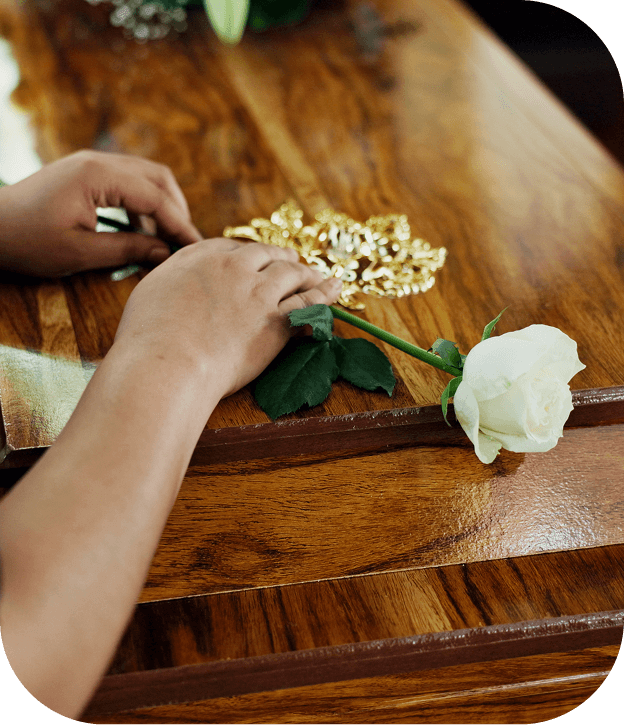
A good funeral director will always present your options clearly and without pressure. If you feel steered rather than guided, it is worth speaking to someone else.
- Ross Hickton, Past President, SAIF
The main funeral options available in the UK
Here is an overview of the main choices available to families today. These are not mutually exclusive, and many families combine elements from more than one.
A traditional funeral service
A traditional funeral typically involves a service at a crematorium, church or other venue, and is attended by family and friends. It is followed by cremation or burial. The service usually includes music, readings and an opportunity for those present to pay their respects in a structured, formal setting.
Traditional funerals remain the most common choice in the UK. They can be deeply meaningful, particularly for families where the gathering itself is central to how they grieve and remember.
Direct cremation
Direct cremation is a cremation that takes place without a service or ceremony at the crematorium. The cremation happens privately and the ashes are returned to the family afterwards. Many families then hold their own memorial gathering, at a time and place that feels right to them.
Direct cremation has grown significantly in popularity in recent years. It suits families who prefer simplicity, who want to plan a celebration of life in their own way, or whose loved one expressed a preference for something understated. What is direct cremation
Attended cremation
An attended cremation sits between a traditional funeral and a direct cremation. A small number of family members are present at the crematorium for a brief, informal gathering before or during the cremation, without the formality of a full service. It offers a moment of presence and farewell without the scale of a traditional funeral. Attended vs unattended cremation explained
A celebration of life
A celebration of life is a memorial gathering that focuses on who the person was, rather than following a traditional funeral format. It can take place at any venue, at any time. It can be as formal or informal as the family chooses. It might include personal stories, music the deceased loved, photographs and moments of laughter as well as grief.
Celebrations of life are often held after a direct cremation, but they can also follow a traditional funeral. Many families find that this less structured format gives them more freedom to honour their loved one in a personal and meaningful way.
A simple or low-cost funeral
A simple funeral is a full funeral service, but without some of the more expensive elements such as an elaborate coffin, a hearse or a large venue. It can be a dignified and meaningful choice for families who want to mark the life properly without the financial pressure of a more elaborate service.
It is worth knowing that simplicity doesn’t mean lesser. Some of the most meaningful funerals are also the simplest.
A graveside or woodland burial
For families who feel strongly about burial rather than cremation, options include a traditional cemetery burial and a growing number of natural or woodland burial grounds. These burials focus on environmental sustainability and a return to nature. Woodland burials have grown in popularity as attitudes toward death and legacy have shifted.
Personalising a funeral: what is possible today
Whatever format you choose, there is considerable scope to make it personal. Funerals today can include almost any music, whether that is a hymn, a favourite song or something entirely unexpected. Readings can be poetry, prose, lyrics or a personal letter. Venues can range from a crematorium chapel to a village hall to a favourite outdoor space.
A good funeral director will help you explore what is possible. They will not tell you what a funeral should look like. They will ask you what your loved one was like, what mattered to them and what kind of farewell would reflect that honestly.
If you are not sure where to start, simply talking to a local, independent funeral director is the best first step. They will listen to what your family needs and help you find a way forward that feels right, without pushing you toward any particular option. Find a local SAIF funeral director
There is no right or wrong answer when it comes to choosing how to say goodbye.
- Ross Hickton, Past President, SAIF
What about cost?
Cost is a reality for most families and it is important to address it honestly. Funeral costs in the UK vary significantly depending on the type of service, the funeral director and the location. Direct cremation is generally the least expensive option. A simple funeral sits in the middle. A full traditional funeral with a hearse, flowers and a large venue is typically the most expensive. Some options offer viewing of the deceased, and some do not. This can also be a cost which could be reviewed depending on family needs.
Whatever your budget, there are meaningful options available to you. A SAIF funeral director can give you a clear, itemised breakdown of costs for any option you are considering, with no obligation to proceed.
The most important thing
There is no right or wrong answer when it comes to choosing how to say goodbye. What matters is that the decision reflects who your loved one was, what your family needs, and what you will feel at peace with in the years ahead.
Take the time you need. Ask all the questions you may have. Speak to a local funeral director who will help you find the right path, not just the easiest one. Explore your options in more detail
Frequently asked questions
What funeral options are available in the UK?
The main options are a traditional funeral service with cremation or burial, direct cremation (without a ceremony at the time), attended cremation, a celebration of life, a simple or low-cost funeral, and woodland or natural burial. Many families combine elements of more than one, for example a direct cremation followed by a personal memorial gathering.
What is the difference between a funeral and a celebration of life?
A traditional funeral follows a structured format, usually at a crematorium or church, attended by family and friends. A celebration of life is a less formal memorial gathering focused on who the person was, which can take place at any venue, at any time, and in any format the family chooses. Both are valid and meaningful.
Can you have a memorial after a direct cremation?
Yes. A memorial gathering can be held at any time after a direct cremation, at a location of the family's choosing. Many families find this separation helpful, as it gives them more time to plan something personal and to gather those who mattered most to the deceased.
What is the simplest type of funeral?
Direct cremation is generally the simplest option. The cremation takes place without a service, and the ashes are returned to the family. It is also typically the least expensive option. However, simple does not mean lesser, and many families hold a deeply meaningful memorial gathering afterwards.
How do I know which funeral option is right for my family?
Speaking to a local, independent funeral director is the best place to start. They will take the time to understand your family's wishes and circumstances and help you explore all the options available, without pushing you toward any particular choice. Find a SAIF funeral director near you
Key takeaways from this guide
- There are more options than most families realise, from a traditional funeral to direct cremation, a celebration of life, a simple service or a woodland burial.
- A memorial gathering can be held at any time after a direct cremation. The cremation and the farewell are separate decisions.
- Every option can be personalised. A good funeral director will ask who your loved one was, not just what package you want.
- Cost matters and there are meaningful options at every budget. Always ask for an itemised breakdown before committing.
- The right choice is the one your family will feel at peace with. Take the time to understand your options before deciding.
Not sure where to start?
A local, independent SAIF funeral director can walk you through every option available, at no obligation. Enter your postcode to find someone near you who will listen first and advise second. Find a local SAIF funeral director
The right funeral director will make you feel heard, respected and supported every step of the way.
Find a local funeral director
Use my current location